Tuesday, April 22, 2014

Historic Williamsburg, Virginia


Did you know that Williamsburg was the capitol of our great nation for a short while in the early 1700’s.  We were not planning on going to this little town but a gentleman from OH, that we met shortly in a museum in DC, said we just ‘had to’ go there because it was so fantastic and we would really enjoy it.  So, after seeing everything we could see in DC and without much hesitation we headed Kemosabe down the road to VA, about an hour and half south of DC to park at a campground there for five days.

Upon arriving at Historic Williamsburg -  www.colonialwilliamsburg.com
we paid our admission and hopped on the shuttle bus not knowing exactly what we were going to see. 
We were very pleasantly surprised to see a town that has been recreated to look like it was in the 1760’s.  Now I know what you are thinking…yeah, yeah, lots of places are little towns made to look like old towns.  This one they did up right and what impressed us the most was that it didn’t have the ‘touristy, commercial’ feel that we so often see.


The original houses, churches, courthouse, palace, taverns, storefronts in about a six block radius had gone through many years of ownership, disrepair, destruction and misuse.  In the 1920’s the people in the surrounding areas decided they needed to preserve this special town and started buying up the property and houses and restoring them.  If a building was torn down, then they rebuilt one on the original foundation from blueprints or pictures that they found in the archives.  Not all the buildings on the street are open to the public; they were never restored on the inside, just the outside.


Reconstructed from original blueprints the old courthouse
All the people who ran the shops, did work in the livery stable, shoe shop, blacksmith shop, garden store, millinery shop, general store, courthouse, restaurants, etc, were all dressed in period costumes.  One of the fun things you can do there is rent a period costume for the day (which a lot of the children did). 


They also have carriage rides, forming of the militia guard (including musket firing and cannon shooting), and my favorite…a speech by Thomas Jefferson himself. 


 At 4 o’clock we sat at a public outside meeting place to hear him talk about the revolution and the signing of the Declaration of Independence.  He talked as if he was talking to us in 1776 (he was a professional actor with great oratory skills). 
Old Tom was very believable and he talked for over half an hour nonstop.  He opened the talk at the end with questions from the audience.  It was interesting because the issue of him owning slaves and writing the “all men are free” declaration came up and he answered it very eloquently and in true 1776 style. 


Two fun things we did was go to the tavern for a demonstration by actors (in costume) on how plays in the late 1700 were banned by many of the original states and what that meant to the citizens living in Williamsburg and how the actors continued with their acting careers and plays.  At one point the acting company had to move to Jamaica for six years to remain in business.  The reason plays were banned was because money was very tight because of the economy, with the war with England, which was going to cost a lot of money and they didn’t want the good citizens to spend their money ‘foolishly’.


Next, it was off to a county courtroom where they asked for any volunteers to act and read from scripts of actual accounts of citizen that came to court in the 1700’s.  George and I volunteered to be fellow judges (you didn’t have to know law in those days to be a judge, just prestige and money…has that changed any in over 300 yrs?).  We heard each citizen place his claim and then we four judges had to agree or disagree to the head judge’s judgment on the case.  It was very fun to experience firsthand the ‘reenactments’ and how it would have been back in the 1770’s.  One interesting fact:  a criminal, no matter what his crime, was only sentenced to a maximum of one year in jail, and then he was let out.  If he did it again…same sentence…no long term prison sentence back then.
King George signing those rascals to the jail.
Our last thing we did was go to their museum and spent our last hour there.  We went through it pretty fast because I can tell you I’m about ‘museumed out' after spending 11 days in DC.  Only item I bought at Williamsburg was a hand fan…boy, could have used it in DC!  Visit their website:  www.history.org


All-in-all I’m glad we stopped off at Williamsburg, it gave me a different perspective on how living was like in VA in the 1770’s.  And the BEST of Williamsburg was no ‘gaudy’ tourist trinkets.  They had shops that sold things, but they were shops like the general store that only sold things that you could buy in that era.  


 Do you like our new look?


The millinery shop had hats that were made on site, shoe shop had shoes made on site, children’s toys were only those toys found in use in that era, the garden area only sold seed and plants grown in their garden, general store only sold root beer and ginger beer that was bottled in original 1700’s looking bottles and candy of that era.  So, yes, I thought they did a great job of keeping the town authentic and I would recommend this place to anyone visiting DC or the surrounding area.
Dressmaker


Silversmith shop


We went one day into Norfolk, VA to see the biggest Naval Facility in the US and take the tour.  They never let us off the bus, so just pictures from the bus. Then we stopped into the Douglas McArthur (WWII famous General) Museum and I was in and out in about 15 minutes…just can’t do it anymore folks!


Then it was off to Virginia Beach and had a great seafood lunch and then walked on the beach for about an hour.  The beach front area is very touristy and lots of gaudy tourist shops, bars, clubs, high rise hotels. I enjoyed visiting the ocean again…I missed the ocean.  We haven’t been on a beach to put our little feet into the warm salty water since we were in MA, above Boston.


I am so glad that I sat next to the nice gentleman in DC because if I didn't hear about Historic Williamsburg I would have missed out on a gem that both George and I thoroughly enjoyed.  The saying 'go for it' could definitely apply to this adventure.


Happy Travels,                                                                                                                         
 Peggy (George & Coco too)

Wednesday, April 9, 2014

Intercourse in Pennsylvania


“Honey, can we experience Intercourse in Pennsylvania,” I asked as I winked at George across the kitchen table.  “Why, of course we can, but aren’t you a bit frisky for this time in the morning?”  “Oh…no”, I replied, “I meant the town of Intercourse”.  “Oh”, replied George with a look of  disappointment in his eyes.

We quickly packed a lunch and took off for a day of exploration to Lancaster County, PA which is so famous for the huge and beautiful Amish farms and scenic landscapes. 


 George was so excited to see farmers out in the fields with horses pulling plows. 


 We stopped by a local farm and bought the best fruits and vegetables (and cheap) from a delightful young Amish young lady.  Passing buggies of families going into town gave us a real sense of being in Amish country.

As we pulled up into the city of Intercourse I chuckled because I just thought that to have a town named Intercourse in the middle of strict and religious Lancaster County was such an oxymoron.  The town was named such because it was the intercourse of two roads leading into town back in the 1800’s. Of course, they had to cash in on this funny play on a word, so instead of renaming the town, they built a city block of small shops and stores to sell to the busloads of tourists the latest Amish crafts, quilts and good food.  No tacky tee shirt stores or salt water taffy here…thank God!

They even had a band playing for the tourists
Fall decorations
Amish yarn
Amish quilt designs on stained glass wind chimes
 
On one of the brochures for the area was an ad to visit the Sturgis Pretzel Factory in Lititz, PA.  I really wanted to go to a pretzel factory so off we went with visions of huge pretzels in our future.  As we drove through the cute little town we spotted the giant pretzel outside the building and knew we had arrived.  The building is actually on the National Register of Historic Places. 
We excitedly gave them the $6 per person to learn how to make a handmade pretzel and shop tour.  Considering it only takes two seconds to make a pretzel and the tour was only in one small room, we knew this was only going to take us 15 minutes max.  I rolled out the doe and then he tells all of us to pick up both ends and cross them over and give them a swing.  Easier said than done but after a couple of tries I managed to get a pretzel that looked like a pretzel not a new animal from the black lagoon!  They didn’t let us bake them or eat them because of sanitary reasons.  The young tour guide showed us the original ovens where they baked the pretzels so long ago.  They are now made in a big warehouse somewhere in an adjoining town.  The company was started in 1861. They were the first commercial pretzel bakery in the US.  Did you know that the Pennsylvania Dutch believed that pretzels brought them good luck, so they had their children wear them around there necks on a string.

After the five minute tour of the wood fired ovens we were escorted into the gift shop and we purchased two bags of their delicious cinnamon coated pretzel sticks.  Wish I had purchased a case of them, they were that good.  We had them all eaten before we left the state!  Look at their website for more info. www.juliussturgis.com

As we drove home later that day I asked George if he liked Intercourse.  Of course, he answered…with a wink and smile on his face while crunching on cinnamon pretzels.
Happy travels,
Peggy (plus George & Coco)

Wednesday, March 26, 2014

Quebec City, Canada


On the southern shore of the Saint Lawrence River the British built  Fort Levis. It was to protect Quebec City from the Americans in the war of 1812. It is an active military base still today. It houses the Canadian 22nd Regiment and along with the Governor General of Quebec Providence, who has a summer house within the Fort. The fort was built in the shape of a half pentagon with large guns at each point with high walls made of dirt and ditches dug in between. The Fort served as a weaponries warehouse and barracks for troops waiting to be sent to Europe in World War I and II. It was during WWI this regiment was honored. They took a strategic city in Germany; one that no one else could take and so honoring the country of Canada. Canada upon this victory was revered globally, recognized as a major military country and with that Great Britain would give them their independence. There is a large Gaelic cross on the grounds to honor those soldiers of that victory. They still post guards at the front gate dressed in Canadian red with large black fur hats.
 

Within walking distance of the old fort lays the city of Quebec. Built within the city in 1805 is the Sainte-Anne Hotel. It looks like a large fairy tale like castle. In front of the hotel is the monument to Samuel de Champlain to honor the founder of Quebec City.

We walked the charming city streets where we viewed art shops, tourist’s shops and French style sidewalk cafés. As we sat and sipped wine at a café in Old Quebec City while viewing the tourists walking within this picturesque city,  Peggy asked me if this was what Paris would feel like. We saw two of the largest churches within the walls of the city, Notre-Dame de Quebec Basilica-Cathedral and St Andrew Presbyterian Church. St Andrew is where the Scots from Wolfe’s army would gather. It has a very large stained glass window. In the distance we could see the neo-Gothic steeple of Chalmers-Wesley Methodist church.


Montmorency Sepaq Falls

We headed up the highway to climb to the top of Parc de la Chute Montmorency Sepaq (falls), up 487 steps.  This awe-inspiring site is 272 ft. tall; Niagara Falls is only 98 feet high. From atop the falls you can view all of the St. Lawrence River way. This is where Montcalm (French) and Wolfe (British) fought for the control of Canada. This war did determine the destiny of Canada. This area would eventually be divided into Quebec and Ontario and the British would ultimately create the union confederation Providences known as Canada. This is where others from General Wolfe troops would gather on Sunday during the war of 1812. 

Peggy on the long climb...up..up & up!


After spending several hours climbing and hiking we then took a ride in the car across the bridge to Ile d’Orleans Island.  My legs were sore from all the climbing and walking we had done in the last two days. This is the largest island in the waterway and is covered with many types of agriculture; apples, strawberries, grapes, corn, dairy, several berries types and wineries. We stopped at the Domaine Steinbach winery and purchased two bottles of Ice wines and a jar of tomato-jelly.


The old hotel and officer's quarters


These were the giant heaters that dried all the clothes of the immigrants
One of the old shower stalls that were used


One of the many graveyards - just a representation
One of the old quarantined hospital buildings still standing


Young tour guide dressed like a nurse
Saturday we took a boat ride across the south channel to Grosse-Ile (Isle-Aux-Grues) Island. I would compare this to Ellis Island in New York City. From 1832-1937 it was a transition point of more than four million immigrants. In 1837 during the potato famine in Ireland more than 90 percent of immigrants were Irish. There are over 7,000 bodies buried on the island, mostly from 1837-1839.  Either Typhoid, Smallpox, Influenza, etc. killed a lot of the children and women. There are two churches on the island - Catholic and Anglican.
There were three hotels on the island too, one for first class, one for second class and tents for third class passengers, (barracks were to come later). We checked to see if our names were on the list of those buried there and found we didn’t make the list.  We finished by viewing the Decontamination Center. Any ship passing down the St Lawrence River was stopped and inspected for health problems. If they found only one person on that ship…any class, first, second or third, they were required to stop and all were to be inspected. All clothing and suitcases were put through a large decontamination heater to kill bacteria, along with any insects. All the people, no matter what their class, would be required to take hot showers where the water contained small amounts of mercury. The clothes they were wearing were then sent onto the decontamination boilers below. They were then inspected for any health issues. If cleared, they would spend seven days on the island then released and ferried back to their ships that had been cleaned too, allowing them to move on to their destination. The island was divided into three divisions, the west side where those who had no health issues awaited their departure. The center was where the doctors, nurses and staff lived. The east side was where those with major hospital requirements were stationed, each section divided by a fence and guards. There were three cemeteries where mass graves were dug and those who were buried were put in simple wooden caskets, stacked on top of each other.  The cemeteries were divided by religion; Catholic or Protestant. Over 8 million left Ireland because of the potato famine, which had the largest death totals of any one country of modern times without a war. Canada not only encouraged the migration but enticed them by giving them 160 acres of free land in the western Providences. Canada was concerned that US citizens might move into those Providences and they would take the land like they had done in Texas from Mexico.

Well, my legs were tired from all that walking and it was raining, so it was a good day for some down time.  While Peggy went to the grocery store to resupply I took a nap...it is good to be King George! 
                                                                     
Happy travels,
George (plus Peggy & Coco)

Saturday, March 15, 2014

St. Augustine, Florida


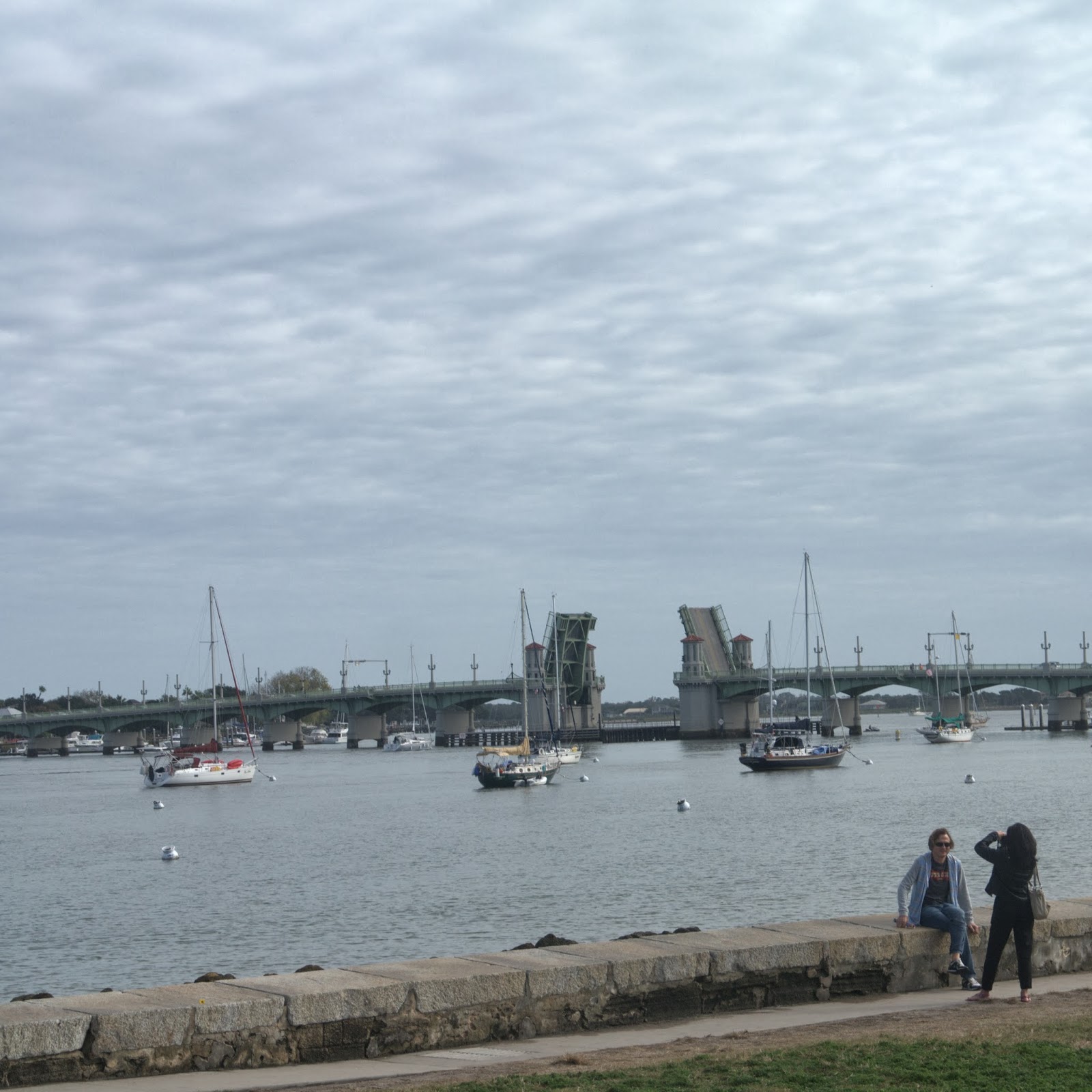
We stayed at Anastasia State Recreation Area, which is a 1,600  acre Florida State Park located on a peninsula on the Atlantic coast of Anastasia Island across Matanzas Bay from downtown St. Augustine. You don’t want to get caught on that draw bridge during rush hour.


The park has a variety of wildlife, birds and plants in a setting of beaches, tidal salt marsh, marine and upland hammock.


There were many activities including bird and wildlife watching, camping, fishing, sun bathing, surfing, sail boarding, swimming and kayaking. Amenities include a campground and nature trails, and the park is unique in being the site of a quarry from which the coquina stone used in the construction of the Castillo de San Marcos Fort in St. Augustine was mined.
Arch made out of coquina stone


 In the current city of St. Augustine is the Ponce de León Hotel. It is a fashionable hotel built by millionaire developer and Standard Oil co-founder Henry M. Flagler. The Hotel Ponce de Leon was designed in the Spanish Renaissance style. It was constructed entirely of poured concrete, using the local coquina stone as aggregate. The original hotel also was wired for electricity. The power being provided by D.C. generators supplied by Flagler's friend, Thomas Edison.


On our walk about town we saw several building including the Fort built of coquina stone. It is a sedimentary rock that is composed of fragmented sea shells. For a sediment to be considered to be a coquina, the average size of the particles composing it should be 1/2 inch or greater. Coquina can vary in hardness from poorly to moderately-cemented. The term "coquina" is derived from the Spanish word for cockleshells or shellfish. Over the century with environment settings and strong waves and currents resulted in the vigorous fracturing of shells, composites were developed.  Well-developed beds of coquina were readily available from a nearby quarry, whereas wood was not as available or as strong, so coquina was used for building materials by the Spanish.   

 We used the local Lighthouse for our navigation around the town; giving meaning to the saying ‘the lighthouse will navigate by land and sea’.


We'll never forget the Christmas Lights in St. Augustine, near the river and bay.  Florida’s historic coast was the setting for this year’s 20th year of St. Augustine’s Night of Lights. During the Nights of Lights, St. Augustine is aglow with holiday magic. From the ground to the rooftops on every tree and bush the sight is surreal.


 National Geographic, in 2011 & 2012, listed them as one of the ten best holiday lighting displays in the world! St. Augustine’s Nights of Lights features millions of tiny white lights that create a magical atmosphere in the nation’s oldest city. Tracing its origins to the Spanish tradition of displaying a white candle in the window during the Christmas holidays, the spectacular lighting reflects the city’s 448 year history. The illuminated beautiful setting will always be one of our lasting holiday memories.


In this smaller town we passed on the bus tours, but parking was not easy. The Ripley’s Believe it or Not Museum parking lot was free and easy to access. Robert Ripley was a frequent visitor to St. Augustine and stayed at Castle Warden Inn often, however he did not create the museum. He died in 1949 and a year after his death, the Castle Warden was purchased to be the ideal,
My dear wife making googly eyes at Captain Jack Sparrow!
uniquely glamorous building to house his collections. The museum includes weird sights for family members of all ages. This collection included real shrunken human heads that Ripley collected on his trips to South America. He was also interested in pirates. The Peel Car which is the world’s smallest production car was on display. It was this young man’s dream to marvel at the largest operational erector set Ferris wheel.  Ripley, over the years was given various gifts from the famousto the common man and they are all on display. You can even take a picture of yourself with “The Lizard Man”, a two headed calf or various unusually formed animals. On display were pictures of the tallest and shortest and the heaviest men. There were over 800 unique exhibits, artifacts, art work on exhibition that amazed us. I can see why they made a movie of his collection back in the 80’s.


Happy Travels,

George (with Peggy & Coco)


Monday, March 3, 2014

Phoenixville & Bethlehem, Pennsylvania


I really show my age by knowing what the movie “The Blob” was all about.  For all our friends and relatives out there over 50…maybe you will remember that 60’s movie classic.  George & I really like to go to little towns and discover what is unique about them.  When we went to the Phoenixville Museum in Phoenixville, PA, the lady told us that the movie “The Blog” was partly filmed there.  The scene where Steve McQueen came out of the movie theater with all the other teenagers screaming their heads off, that was filmed at a movie theater in downtown Phoenixville.  Who would have known that, surely not me…I’m too young to remember that!  Here is the picture of the front of the theater. 


Does it bring back memories for any of you youngsters?  If not, then rush to the internet and see what the movie was all about; it was such a scary movie in the 60’s.

When we decided to drive to Bethlehem, we didn’t have anything specific to see, just wanted to see the countryside and enjoy a smaller town in PA.  Were we shocked when we arrived in Bethlehem.  First off, the town was named because it incorporated on Christmas Eve, 1741 by German missionaries and so they decided to name it appropriately because of that special day.  It was a big steel town from 1869 to 2001.  We expected it to be depressed and dirty and it was quite the opposite.  The main downtown area has been restored and it has three blocks of shops, lots of restaurants and a huge hotel.  The historic Bethlehem Hotel stands majestically on the main street overlooking the Monocacy River.  We went in to the hotel to check it out.  As we were walking around admiring the lobby a nice lady came up and introduced herself as the hotel manager and proceeded to give us a personal tour of the hotel. 
In the ballroom were these huge tapestries that depicted the scenes of Bethlehem and its origin.  They do a lot of weddings and anniversaries in that ballroom. 


I just love small towns and what a delight to experience such hospitality and fun walking the streets and having lunch at a local restaurant on a perfect summer day.  The town really had a struggle around 2000 when the steel mill shut down and the town really took a dive.  But, over the years they have come back and are trying to survive. So pleased to see the delightful town prospering now.
                                                 Isn't this the most original book shop name!

                                     Talk about cute...this was in a store window on main street
Woolworth Store....brings back memories


 Drove down to the visitor’s center for Bethlehem Steel Company and they just had a small new building that showed the mill’s history, etc.  They only had one afternoon tour and we missed it…bummer...so just took pictures.

Bethlehem Steel Company, founded in 1869, was one of the top producers of steel for this country.  They produced the steel for the George Washington Bridge, Empire State Building, Golden Gate Bridge, Madison Square Garden, Hoover dam and one of the largest shipbuilder and the list goes on and on.  When the company went bankrupt in 2001 International Steel Group bought the assets in 2003. The site of the company's original plant is now home to SteelStacks, an arts and entertainment district. The plant's five blast furnaces are left standing and serve as a backdrop for the new campus. SteelStacks currently features ArtsQuest, a contemporary performing arts center, and the Sands Casino Resort Bethlehem, a gambling emporium. The area also includes three outdoor music venues - Levitt Pavilion, a free music venue featuring lawn seating for up to 2,500 people, Air Products Town Square at Steelstacks, and PNC Plaza, which hosts concerts featuring well-known artists. 


Next, we decided that we had to go and photograph the covered bridges that were close by.  So glad we did.  It isn’t everyday you get to see them and we were able to see three and drive through two.  They call them ‘kissing’ bridges because back in the day when it was improper to kiss in public the young people in their horse and buggies could steal a kiss without the chaperone, following behind them, seeing them kiss.  George and I decided we must experience that tradition and stole a kiss in the dark…no one cared.

What a lovely trip into the country and was so glad we got to experience some ‘untourist’ kind of sights.

Happy travels,

Peggy  (plus George & Coco)